



Supplier Risk Assessment: Protect Your Supply Chain from Financial Failure
Supplier risk assessment is not only a procurement exercise. It is a business continuity discipline and an important part of wider risk management. When a supplier comes under financial pressure, the first damage is often not visible in a balance sheet. It appears in delayed shipments, inconsistent quality, missed commitments, emergency sourcing, and rising operational cost.
That is why financial failure in the supply chain is so dangerous. It rarely begins with a formal collapse. More often, it starts with weakening resilience long before insolvency becomes visible. For companies that rely on timely delivery, specialized inputs, or single-source vendors, supplier risk assessment is essential to protecting continuity before financial failure turns into operational disruption.
The real cost of supplier failure
When a customer pays late, the impact is usually visible in receivables. When a supplier weakens, the damage can spread across the business much faster.
A financially unstable supplier can create:
- production stoppages,
- stock shortages,
- urgent replacement costs,
- missed service levels,
- customer dissatisfaction,
- and pressure on margins.
This is why supplier-side risk deserves the same seriousness as customer-side risk. In many industries, supplier weakness causes disruption before formal financial failure is ever declared.
Why procurement teams should care about financial health
Procurement decisions are often driven by price, quality, and delivery capability. Those factors matter, but they are not enough on their own. A supplier may offer attractive pricing and still be financially fragile. If the business depends on that supplier, the apparent savings can disappear quickly once disruption begins.
A proper supplier risk assessment helps procurement teams judge whether the supplier can remain dependable over the life of the relationship. This matters most when contracts are long-term, switching costs are high, or the supplier supports a critical process.
When supplier risk assessment becomes critical
Not every supplier needs the same level of review. The need becomes far more urgent when:
- the supplier is single-source or difficult to replace,
- lead times are long,
- the component or service is business-critical,
- contract values are significant,
- or a disruption would affect customer delivery.
In these cases, a basic onboarding review is not enough. A more structured supplier risk check is needed to understand how much financial weakness the relationship can realistically absorb before supply-chain performance is affected.
What businesses should look for
The most effective reviews focus on resilience, not just existence. The question is not only whether the supplier is active today, but whether it is likely to remain dependable under pressure.
Financial resilience
A supplier under cash-flow strain may still be operating, but with much less room for disruption. Rising liabilities, thin liquidity, weaker profitability, or growing dependence on a small number of customers can all reduce resilience. This is where a company credit report can help decision-makers judge whether the supplier’s profile supports long-term confidence.
Dependency risk
A supplier does not need to be high risk to become dangerous. Even a moderate-risk vendor can create serious exposure if your business is too dependent on it. That is why a vendor risk check should consider concentration, replaceability, and lead-time sensitivity alongside financial signals.
Early signs of operational pressure
Financial weakness often appears in operations before it becomes obvious in formal filings. Slower responses, delivery inconsistency, quality drift, unusual commercial behavior, or requests for changed payment terms may all indicate pressure building behind the scenes.
Corporate reliability
A proper review should also consider whether the supplier appears stable as a business. This is where business verification remains important. A business information report can help confirm identity, operating status, and core company background. These details matter because weaker transparency often undermines confidence in overall company financial reliability.
Warning signs that often appear before financial failure
Businesses should pay close attention when a supplier begins to show:
- repeated delivery delays,
- sudden changes in payment requests,
- unusual management or ownership changes,
- weaker communication or responsiveness,
- lower quality consistency,
- or signs of dependence on a narrow customer base.
These signals do not always confirm immediate failure, but they often indicate that the supplier’s financial resilience is weakening. In many cases, this is the stage where early action is still possible.
Why one review at onboarding is not enough
A supplier approved last year may not represent the same level of risk today. Market conditions change. Input costs rise. Financing becomes tighter. Key customers are lost. Management changes. A previously stable supplier can move closer to financial failure within a relatively short period.
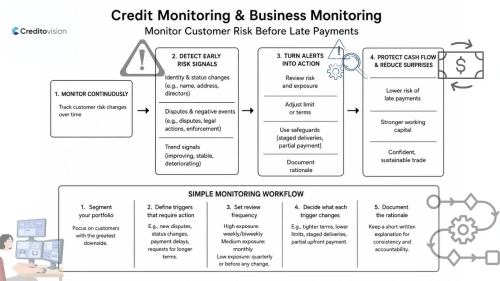
That is why businesses should not rely only on a one-time review. Supplier monitoring helps maintain visibility after onboarding, especially where supplier dependency is high. For more critical relationships, supplier risk monitoring supports earlier detection of deterioration before it turns into missed deliveries, emergency sourcing, or wider operational disruption.
How supplier risk assessment supports stronger supply chains
Used properly, supplier risk assessment does more than identify weak vendors. It helps businesses make better sourcing decisions from the start.
It can support:
- more disciplined supplier selection,
- earlier contingency planning,
- better prioritization of critical vendors,
- stronger alignment between procurement, finance, and operations,
- and lower exposure to avoidable disruption.
The goal is not simply to reject risk. It is to understand where risk sits in the supply chain and manage it before financial weakness becomes a commercial problem.
A practical way to think about supplier risk
A supplier should not be judged only by whether it looks acceptable today. It should be judged by whether it can remain reliable under the demands of the relationship.
That means asking practical questions such as:
- How hard would this supplier be to replace?
- What happens if deliveries slow down for four weeks?
- Does the supplier’s financial profile support the scale of our dependency?
- Are we exposed to a quiet deterioration that operations will notice too late?
These are the questions that make supplier risk assessment commercially useful. They connect financial review directly to supply-chain resilience.
Supplier risk assessment is critical because financial failure in the supply chain rarely starts with a visible collapse. It starts with weakening resilience, growing dependency, and warning signs that are easy to ignore until disruption becomes expensive. When businesses assess supplier risk early and keep critical vendors under review, they strengthen risk management and protect not only procurement decisions, but also continuity, customer delivery, margin, and operational stability across the wider supply chain. To support your supplier review process with dependable credit reporting and company intelligence, visit the Creditovision portal: https://portal.creditovision.com/login